Showing posts with label Bird Banding. Show all posts

Wednesday, May 25, 2011

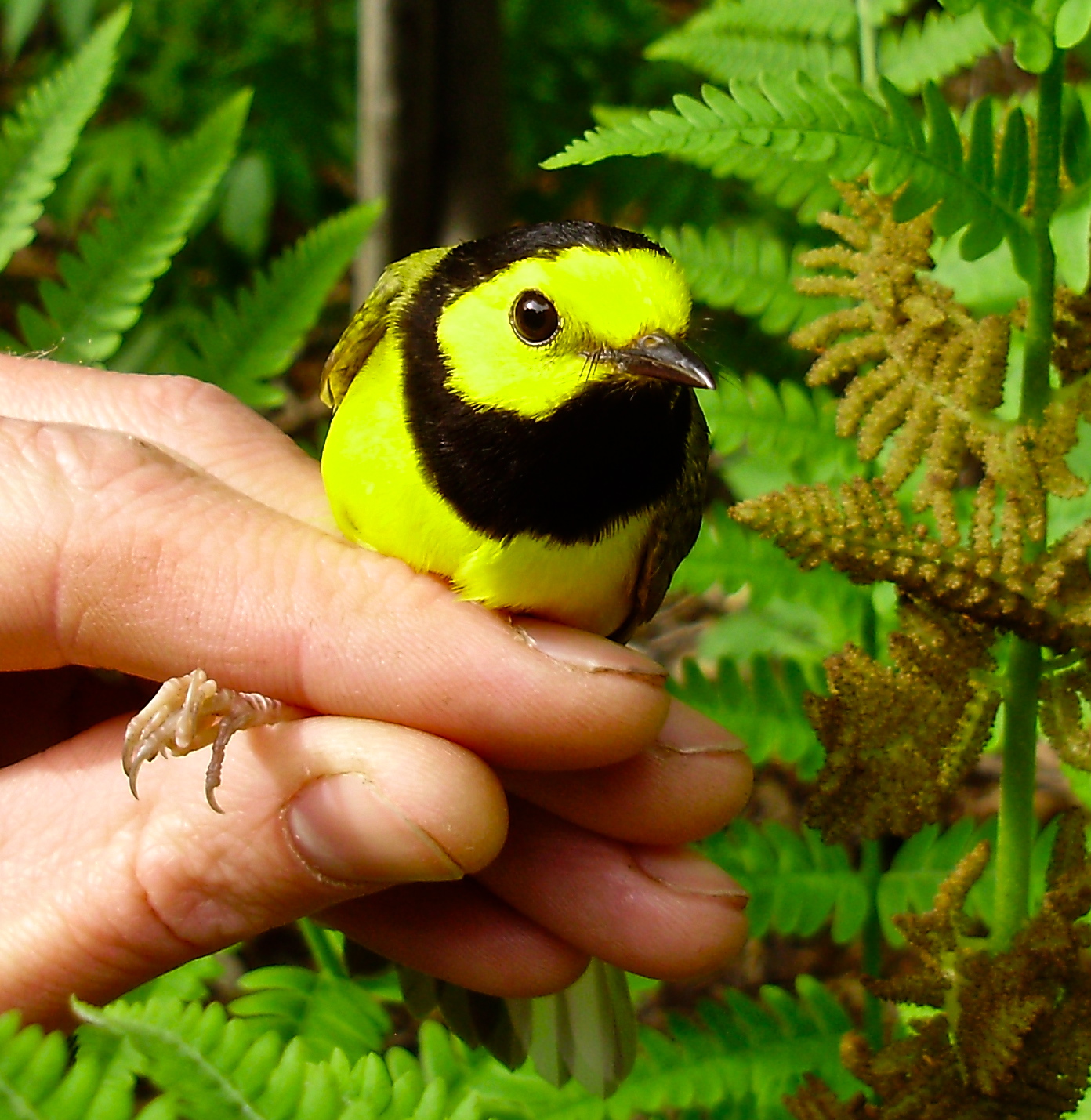
Male Hooded Warbler Photos from today's Banding

Posted by Kirk


Today at work our bird banding crew pulled this gorgeous male Hooded Warbler from the nets. It's very rare to see a Hooded Warbler on site and even rarer to band one. The reason has to do with their breeding range. Take a look at this map from the USGS made using Breeding bird Survey data. The nearest breeding population they show is in Illinois and Michigan.


Still, these birds are seen in Minnesota. Looking at eBird data from Cornell it is easy to see there have been four sightings in the last 30 days and this is taking into account that not that many birders in Minnesota even submit their sightings to eBird. They are known to nest in Murphy Hanrehan park.


This was a male and I've heard him or maybe a buddy singing on site this spring. The real question is, is anyone listening. These males can come sing all they want but if there aren't any females listening there isn't going to be any breeding going on.

I like the photo below because you can see two really cool things. You can see the band we've attached to the bird's leg as well as the cool whiskers this bird has around the mouth. I usually associate these whiskers on birds with the flycatchers. Whiskers such as these help direct insects into the bird's mouth while they are chasing after them. Very cool.

~Kirk
Read More

Thursday, April 21, 2011

Have you seen Bird Banding?

Posted by Kirk
A number of friends appear in this nice Three Rivers Park District video about Bird Banding. It explains a bit about the process. If you've never seen a bird banding demonstration before you owe it to yourself to check it out.

Read More

Tuesday, November 9, 2010

A Shrike in the Hand

Posted by Kirk
Probably the most exciting bird caught in the nets during this fall's banding season was this beautiful Northern Shrike. The banding process begins by stringing up special nets around the nature center and then waiting for birds to fly into them. Net runners monitor the nets and run any birds they catch back to the bird banders. Paul was the lead bander this particular day. No one is really excited about sticking their hand into a bag with an agitated shrike though everyone was happy to watch someone else do it. You can see why by looking at the beak.

There isn't really all that much difference between a shrike beak and a raptor beak. Shrikes are efficient predators and have an incredibly shark beak. Banding one is fairly intimidating. We've been banding birds at the nature center for over 40 years now and this is only the second shrike ever caught in the nets. It apparently was attacking another bird caught in the net. Shrike's feet are not strong like a raptor's feet so they kill food by impaling it on thorns. They come back and eat it later after it has died. In the following two photos, Paul is looking at the wings to learn more about the bird before banding it.


The band itself is a simple aluminum ring that is formed into a loose circle around the bird's foot with a special pliers.

Here the bird is just before releasing. There are a number of ways for a bander to hold birds. They do so in ways that will keep the birds safe. The bird's safety is the number one priority.


Once the bird is banded and all information is recorded it is set free. Hopefully, someone will capture this bird again and send the data in to the federal bird banding office so we can learn more about the life of Northern Shrikes.

~Kirk

Photo credit: all photos by Kimberly Woodward
Read More

Thursday, May 20, 2010

Orchard Oriole Banded (with photos)

Posted by Kirk 3 Comments
Banding today turned up some fun birds. I felt vindicated when I heard over the radio that this guy had been caught in the nets. I had caught a glimpse of what I was sure was an Orchard Oriole a couple of days ago. The banders caught and banded a female Orchard Oriole yesterday so it looks like we have a pair of birds on site. Here's the photos.

In this shot the lead bander is checking out the wing. You have to look at various parts of the body to tell how old the bird is.


The deep black color of the tail tells us this bird is "after second year" or in non-bander lingo, he was born more than two springs ago.


Orchard orioles are very pretty but don't get much attention since their cousin the Baltimore Oriole is so much brighter. Still a handsome bird though.


In this shot the bander is putting the band around the birds foot. The tool has special holes in the jaws so that the band can be attached firmly but at he same time not crush the bird's fragile leg. If you look closely you can see the band in the tool.

That's all for now, more migrants on the way though!

~Kirk
Read More

Thursday, March 11, 2010

Trumpeter Swan 75A Update

Posted by Kirk
Last November I wrote about a Trumpeter Swan we spotted at work during migration. A flock of swans took to hanging out at one of our lakes. I went down to scope them out and realized that one of them had a band. It took some doing since they liked to stay as far from us as possible but we finally agreed that the band number was 75A. We submitted the information to the banding office and just this week received a response.

Trumpter 75A was too young to fly when banded on August 23, 2004. The sex was unknown. The bird was banded in Wisconsin, about 8 miles north of Stillwater, MN.

That made the bird 5 years old when we saw at and 6 years old now. (In bird terms, all bird turn a year older on January 1.)

I did a quick map of where it was banded and where we spotted it.

This is really interesting because the bird is not far at all from where it was banded 5 years ago. We saw it on Mays Lake which is a private lake bordered by the Warner Nature Center and private property owned by Wilder Forest. We are 5 miles west of the St. Croix River and what this confirms for me is that the trumpeter swans that sometimes hang out on our lakes in the fall are part of the St. Croix River Flyway. Not unexpected since we are so close but cool to have confirmation. We're just far enough from the river to feel disconnected from it at times. It is nice to know that this prime habitat is used as a resting stop for birds following the river. Now then, if they could just spread the word to other waterfowl that would be great.

The Bald Eagles seem to have caught on to the prime habitat at the nature center and successfully fledged chicks at the nature center for the first time since the center opened in the 1960s. We're keeping our eye out for their return and I'll be sure to write about their nesting attempt this season if they return.

~Kirk
Read More

Friday, October 9, 2009

Name that Junco

Posted by Kirk 3 Comments
An interesting bird showed up at the Lee & Rose Warner Nature Center today during banding. There were three juncos in a net. One was male, one a female and one didn't seem quite right. There are a number of different types of Dark-eyed Juncos in North America. The ones we commonly see in Minnesota are the Slate-colored variety. They are essentially all gray on top and white on the bottom. If you look carefully though you can distinguish males and females as the females are slightly brownish gray on the back while the males are more pure gray.

What caught everyone's eye about the third Dark-eyed Junco, the one in all the photos here, was that the back of the bird seemed very brown but the head did not. In fact, there is no brown on the head whatsoever. The head also seemed to be darker than the rest of the bird but not extremely so.


Our first reaction was to consider calling this an Oregon Junco. The complete lack of brown on the head makes us think male but then again it isn't as dark a black as one would expect. What this comes down to is that there are a lot of intergrades when it comes to Juncos and it can be hard to draw a clear line between different sub-species.

Here's more photos. What do you think? Things to note:

1) No brown on head but clearly brown across back, brown extends slightly onto wing.
2) Bib is convex (like an Oregon Junco), not concave like a Slate-colored
3) Only very limited brown on the flanks


I welcome your thoughts and comments.

~Kirk
Read More

Wednesday, October 7, 2009

How to tell how old a bird is

Posted by Kirk 2 Comments
Today we taught our Fall Migration class so that means bird banding. This was the first non-raining day all week which made for a lot nicer conditions. The lead bander for the day was non other than my co-host on the podcast, Paul Smithson. I took a break during the day to see what they were catching and learn a little more about ageing birds. When I arrived, Paul was taking out the first bird of the day, a Fox Sparrow. This was a treat as it was the first Fox Sparrow at the nature center this fall. I love these big robust sparrows and their feeding behavior. Paul set to the task of gathering information about the bird to be recorded before it was let go. One of the things banders try to determine is how old a bird is. Often the distinction is between a hatching year bird (HY) or after hatching year bird (AHY). In the photo below he's looking at the outer rectrices to see how worn they are.


Here's the diagram banders use to determine the wear on the outer rectrices of a Fox Sparrow. Ideally they would look like one of the two drawings marked "Fall." In reality, that doesn't always work. In this case, the feathers looked somewhere in between the two drawings. He checked a couple of other feathers but wasn't confident enough to make a determination. It was probably a hatching year bird but without enough certain information the age was put down as unknown.
A very different technique came into play while determining the age of all the White-throated sparrows that were caught this morning. In the fall, white-throated sparrows can be aged by looking at the color of the iris of the eye. A hatching year bird will have a grayish brown to brown iris while an after hatching year bird will have a reddish brown iris. The distinction can be subtle and good lighting helps. Can you tell what color the iris is for the bird below? It was only slightly easier in person, which is to say, hard.

I thought it would be fun to include another photo here of a white-throated sparrow. Look at the difference in the heads. There are two different color morphs of the White-throated Sparrow. The one above is a tan-striped morph as the light colored stripes on the head are tan. In contrast, the bird below is a white-striped morph. (The stripes looked even whiter in person)
These are not two different sub-species. They are both represented about evenly in the population. What is really fascinating is that research suggests that the birds almost always mate with a bird that has the opposite color morph. Also, both males and females of the white-stripe morph tend to be more aggressive during mating season. The more aggressive white-striped females are preferred by both color types of males. Ironically, both types of females prefer the less aggressive tan-striped males. So, white-striped females do well and tan-striped males do well while white-striped males and tan-striped females do less well. That's all clear right?

Another fun bird of the day was a Winter Wren. It was the first winter wren caught at the nature center in 2009. I just love that little tail!


That's all for tonight. Thanks for stopping in.

~Kirk
Read More

Thursday, May 7, 2009

How old's that thrasher?

Posted by Kirk
It was a beautiful Thursday at the Lee & Rose Warner Nature Center where my co-host of the Twin Cities Naturalist Podcast, Paul and I work as naturalists. One of the fabulous things about being a naturalist is that you get to spend time outside on beautiful days. Many new migrants showed up today and the school group coming out took the Spring Birds class so that means banding! Fairly early on, the banders caught a beautiful large Brown Thrasher. What a gorgeous bird. Check out that gold eye! I usually think of thrashers as desert birds since that's usually where I see them. There are Brown Thrashers at the nature center every year but for some reason I never seem to stumble upon them. It was a thrill to see it up so close. The photo doesn't even begin to do this bird justice.


The next photo gives you a real idea for the size of a Brown Thrasher. This particular bird had an interesting feature that can be used to age the bird. Banders need to know all kinds of tricks to figure out how old a bird is. Look carefully at the tail of the thrasher. Notice anything?

Sometimes banders look at the condition of tail feathers, the fresher and less frayed, the newer. This tail is a little worn but that isn't the important thing to notice. There's a faint light colored band on all of the feathers about an inch or so from the tip of the tail. Can you pick it out? A variation in color on a feather is not uncommon. Sometimes there are series of bands that correspond to feathers growing at night or during the day. In the case of this thrasher though, there is only one band and it was likely caused by a change in diet while the tail feathers were growing. Most likely there was a minor deficiency in nutrients. You see this from time to time on single feathers. The key thing to note, however, is that the band appears on all of the tail feathers in the same location. For this band to appear at the same place on all of the feathers, they would have all had to form at the exact same time. Adult birds don't molt all of their tail feathers all at once or it would be very hard to fly. Unless there is some freak accident where a bird is attacked and loses all of its tail feathers, the only time all of the tail feathers grow in at once is when the bird is born. Since the band appears at the same place on all of the feathers we can tell that they all grew at the same time. Since the only time that happens is at birth, we know that these are the original tail feathers this bird grew. That tells us this is a first year bird that was born last summer.

This young male was banded and released. Hopefully he'll go on to have a long successful life. From now on, even when he gets new tail feathers, if anyone catches him again they'll know when we was born because of his band.
Read More